Elementary

Elementary I
serving students ages 6 to 9, grades 1 through 3
Sample Elementary I daily schedule.
Six to nine year-olds are in a sensitive period for understanding their place in the universe, the world, their community, their family, and their classroom. The curriculum, rooted in the “Great Lessons,” begins with the birth of the universe and all of the matter that exists today and the laws that bind it together. Next, studies include the solar system and the earth’s creation over billions of years. We examine the contributions of ancient humans and human civilizations through the fundamental needs of all humans. In comparing how ancient civilizations met their needs for food, shelter, safety, and spirituality, we learn that people through time and all over the world are truly more similar that different; we just meet our needs based on what is available in our time and in where we live on the globe. We also use specific timelines to look at the significance of language and numbers in our daily lives. Students explore all of the creatures that have inhabited the planet prior to humans and learn to see themselves as a small part of a continuum of all that has come before us. At the Elementary I level, students are exposed to these concepts through a series of impressionistic lessons.
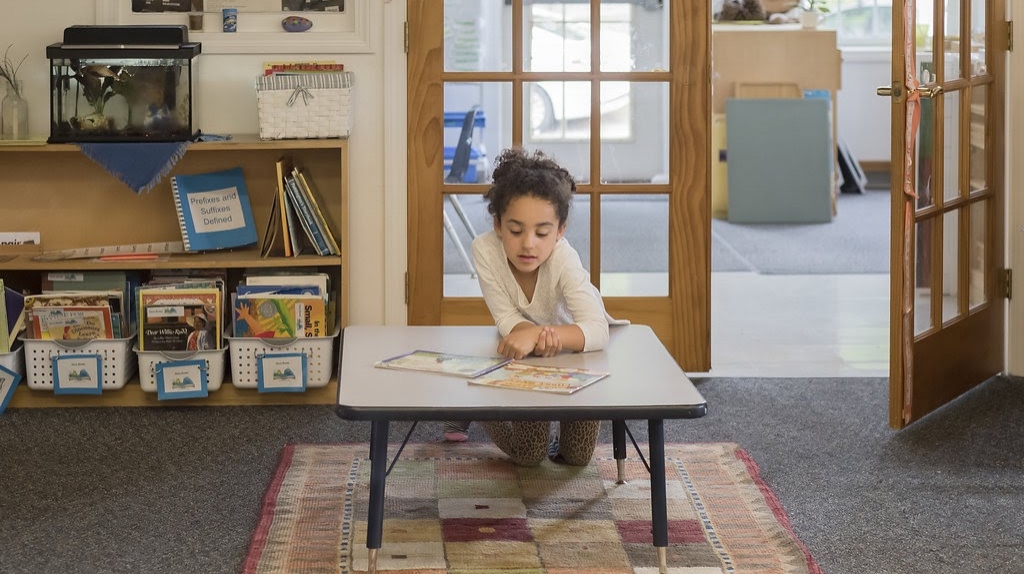
The Elementary I curriculum incorporates a balanced literacy approach that emphasizes the interconnectedness of reading and writing. Montessori trained teachers guide students in building foundational math and language skills with concrete materials and a series of instructed exercises. Our lesson methodology incorporates presentation, recall, and recognition. Mastery comes from repeated practice and demonstration of understanding. Our teachers carefully challenge each student according to his or her developmental needs and abilities. The prepared environment and purposeful activities lead to independent, self-directed learning.
Daily uninterrupted work periods allow for a variety of different kinds of work activities in all curriculum areas including language (grammar, sentences construction, vocabulary, writing) math (basic operations, fractions, geometry), botany, geography, history and more. Clearly articulated lessons guide sequential activities. Independent work plans help students plan their day with teacher support and guidance. Students are given presentations individually, in small groups and in larger groups, and they conference regularly with their teachers to discuss progress and goals. Students are also guided to practice self-assessment. As students become actively involved in their learning, they become more motivated and reflective.
Elementary II
Serving students ages 9 to 12, grades 4 through 6
Each day, we post our EII schedule.

Children aged 9-12 are continuing the transition from concrete to abstract thinking. Our Elementary II program is designed to support this change and guide students as they prepare for the next phase of their academic lives. Although pure abstraction will come later in life, 9-12 year-olds are able to begin conceptualizing abstract ideas.
At the EII level, we continue to introduce new concepts with Montessori manipulatives. Students are encouraged to use these materials in order to enrich their understanding. In the Montessori curriculum at this level students are encouraged to plan, prioritize, and manage their own work through the use of daily, weekly, and monthly goals. Teachers initiate lessons to spark interest and guide students toward independent research in many subject areas. Students present their findings through various modalities and participate in self and peer evaluation as an integral part of the process. In this way, we capitalize on students’ interests while they build independence and confidence.
The 9-12 year-old is in a sensitive period for understanding the complexities of ethical behavior. In EII, we honor this by giving students greater responsibility in building the classroom community. Students not only work together in groups, but also analyze the group process as it is taking place. Students hold community meetings to solve problems and brainstorm ways to take responsibility for classroom management. The students meet regularly with younger Bridgeview Montessori students to form peer mentor relationships. To foster these relationships, EII students have community jobs in throughout the school. They apply for their jobs and interview with Head of School. We have Art Studio Assistants, Snow Pant Helpers, Classroom Readers, Math Fact Helpers and the like. Through these experiences, our students take pride in their accomplishments, acting as authentic role models for younger students within our school community.
Each of these valuable learning experiences is enhanced in EII by the process of metacognition: learning about learning. All students have individual strengths, as well as individual challenges. In the Montessori environment, students begin to understand their own learning styles and use them to develop their best strengths. Reflecting on their own learning helps them to monitor their own progress towards personal and group goals.
World Language in Elementary
Students at Bridgeview Montessori School study Spanish beginning at age 2.9. Elementary students gather with their Spanish teacher weekly to engage in a variety of interactive and immersive activities that help to develop confidence in comprehension and speaking, while gradually expanding their skills in written language and grammar. Through story, music, games and art, students build their Spanish vocabulary in a dynamic and memorable way and experience the inspiring connections between language and culture. We hope to foster an appreciation for different culture through a love for the Spanish language and its rich cultural heritage.
Home Assignments for Elementary Students
We assign a reasonable amount of traditional homework so that children have the time to pursue personal interests that contribute to their development as well rounded, lifelong learners. Our home assignments are designed to allow students to continue developing a love for knowledge, personal expression, and to reinforce skills learned in the classroom. Classroom teachers will provide more information about particular assignments and homework schedules. We ask that parents assist their children in achieving homework success by creating quiet homework spaces and scheduling their time so that they can complete the assignments by the provided due dates.

A First Year documenting his choice for his monthly October Home Assignment: Use Squash in Cooking: This student chose to make squash soup.
Elementary I home assignments are generally literacy-based with students choosing related projects that support their individual learning styles and interests. These projects are to be completed over a period of days, and often involve reading and preparing some type of presentation. Home assignments may be organic or spontaneous extensions of the work being done in class.
Elementary II students are asked to complete both short-range and long-range assignments. Typically, there is a predictable weekly homework schedule. This may include such things as reading with written reflections, math work that is an extension of school lessons, and spelling. Longer research assignments are also completed at home. These projects allow the students to work with long-range planning as they meet multiple deadlines.
Missed classwork and home assignment due to absence is expected to be made up after student returns to school. Teachers are not required to send work in advance of a student’s planned absence. Students and teachers work together to develop a plan for makeup work.